
Example · illustrated children's book
A children's book, from a family story to a printed hardcover
A father wrote a story for his three children. With ChatGPT he illustrated it page by page, typeset it, and prepared the print files. ChatGPT then checked the files with Quantum and placed the order once he approved the price: a 112-page, 8 × 8 inch hardcover, with the story exactly as he wrote it.
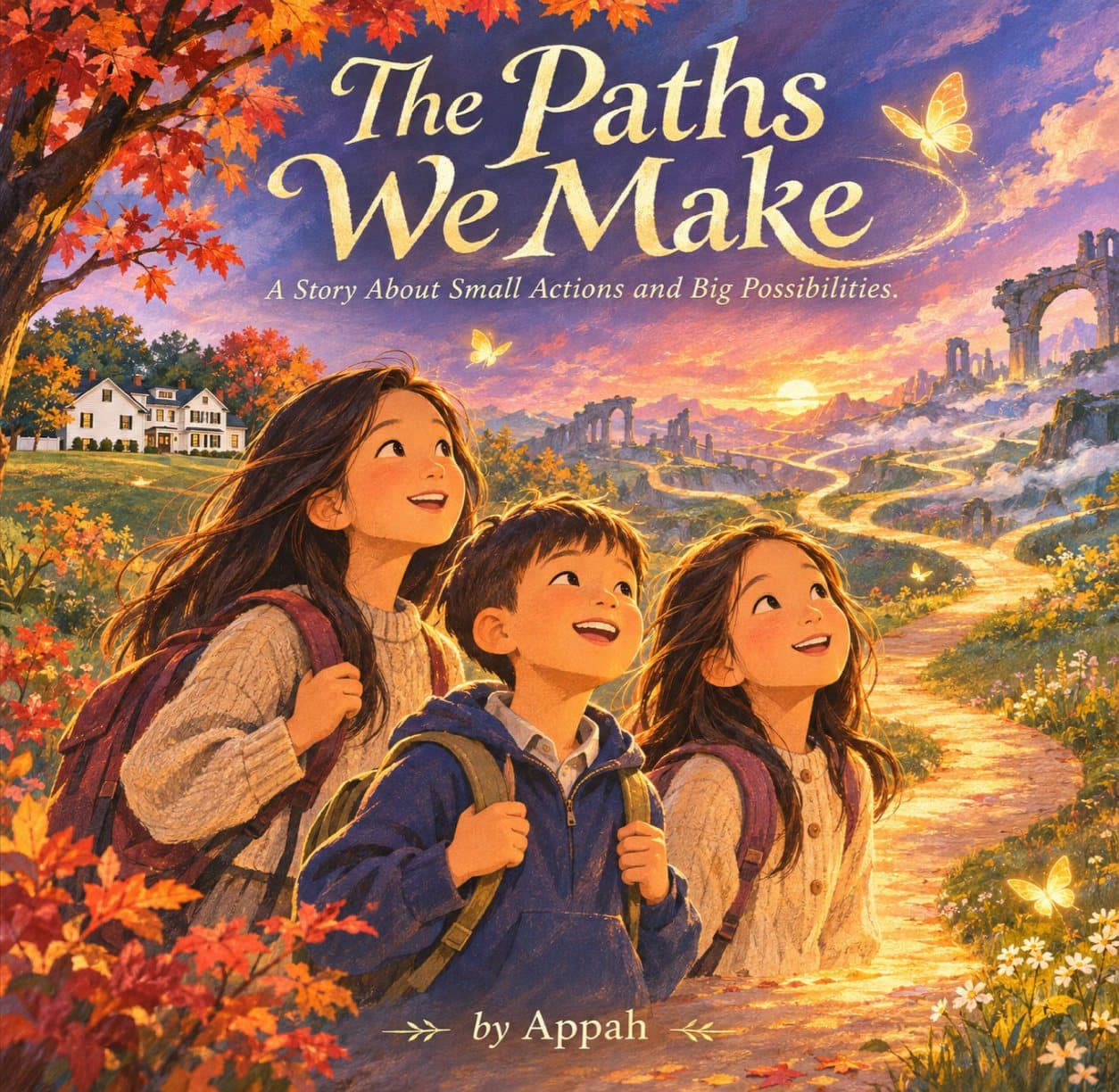
This example used ChatGPT for both the book and the order. The photobook and company-book examples used Claude, and the same steps work in either. New here? Start with how making a book works.
Part 1: make the book
- Start from the finished story. The author's manuscript was the source of truth. The assistant was told never to shorten, paraphrase or add to it: every word on every page is the author's.
- Write down who and what the pictures must show. A short character sheet (who looks like what, in every scene), a scene guide (the places, the seasons, the rules of the story), and a list of what must not appear: extra people, invented animals, words inside the artwork.
- Plan the pages. A page-by-page plan: the exact text for each page, which scene it belongs to, and how it is laid out. Pacing matters in a picture book, so the plan mixes big double-page paintings, full-page scenes, small spot illustrations and quiet pages that are mostly text.
- Make each illustration on its own. One scene brief per picture (the passage, who is in it, the action, the light), made and then checked at full size for the right characters, hands and faces, the right season, and nothing invented. A picture that failed was redone alone, and its neighbours rechecked.
- Set the text separately. The words are real text in the PDF, in an embedded book typeface, placed around the art, never baked into a picture. That keeps them sharp at any size and exactly as written.
- Approve a reading proof. A proof of the whole book, with the cover separate, went to the author before any print file was built. Changes went back into the plan.
- Build the print files at the exact sizes. Single pages in reading order (a double-page painting is split at the middle), full-bleed art out to the edge, and a single flat cover. The diagram below shows the sizes.


The sizes it worked from
At 112 pages each inside page is 8.25 in square (the trim plus the bleed). Good print quality means about 300 effective dpi: for a full 8 × 8 inch page that is roughly 2,400 × 2,400 pixels of real detail, which you can't get by enlarging a smaller picture. Sizes differ by product and page count, so always have the assistant fetch the exact sizes for yours.
Part 2: order it
The order took under four minutes, and ChatGPT did every step itself:
- Sizes. It asked Quantum for the print sizes for this product and page count.
- Upload. It sent the two PDFs, a 42 MB interior and a 6 MB cover, straight to Quantum from where it works, and finished each upload.
- Check. It checked the files against the product.
- Quote. It priced one copy with standard shipping and showed the total, with the sales tax already included.
- Yes. After the author approved the total, it placed the order with the quote, and the order shows in his dashboard as placed through ChatGPT.
What it cost
| 1 hardcover, 112 pages | $20.40 |
|---|---|
| Order handling | $1.50 |
| Shipping (standard) | $3.81 |
| Sales tax | $1.70 |
| Total charged | $27.41 |
Prices depend on your plan and the page count; see pricing for the current numbers.
Prompts you can use
These are general versions of what was asked. Replace what is in brackets.
I have a finished story for a children's book (attached). Treat it as the source of truth and never shorten, paraphrase or add to it. Make a [number]-page [8×8] hardcover for Quantum. Call get_print_specs first. Before drawing anything, write a character sheet for [who is in the story and what they look like], a scene guide, and a list of what must not appear in the pictures (no extra characters, no words inside the art). Then give me a page-by-page plan with the exact text for each page.
Illustrate the plan one scene at a time, in [the style, e.g. hand-painted, warm, storybook]. No words or letters inside any picture. After each picture, check it at full size for the right characters, hands and faces, the right season, and anything I didn't ask for, and redo only the ones that fail. Vary the layouts: some double-page paintings, some full pages, some small illustrations, and some quiet pages of text.
Typeset the text as real text with an embedded font and make a reading proof with the cover separate. When I approve it, build the interior and cover PDFs at Quantum's exact sizes, send them to Quantum, run check_files, and quote [1] copy with [standard] shipping to [address]. Show me the total, tax included, and wait for my yes before you place the order.
What we'd tell you
- Give the assistant the finished story and say it is the source of truth. Otherwise it will tidy your words.
- Words never go inside the pictures. AI art makes pseudo-text. Have the words typeset as real text.
- Look at every picture. The common mistakes are an extra child, the wrong season, a repeated illustration, or something in the picture the story never mentions.
- Keep faces and important details away from the middle of a double-page painting, where the book is bound.
- A hardcover has to be an even number of pages within the product's limits, and the spine changes with the count.
- Order one copy first and hold it before you order more.
Next: a photobook, a company book, or go back to how it works.